The True Cost of Manual Reporting for Marketing Agencies

Most agencies underestimate the true cost of manual reporting.
It’s not just money. It’s wasted time, avoidable errors, slower decisions, and missed growth opportunities.
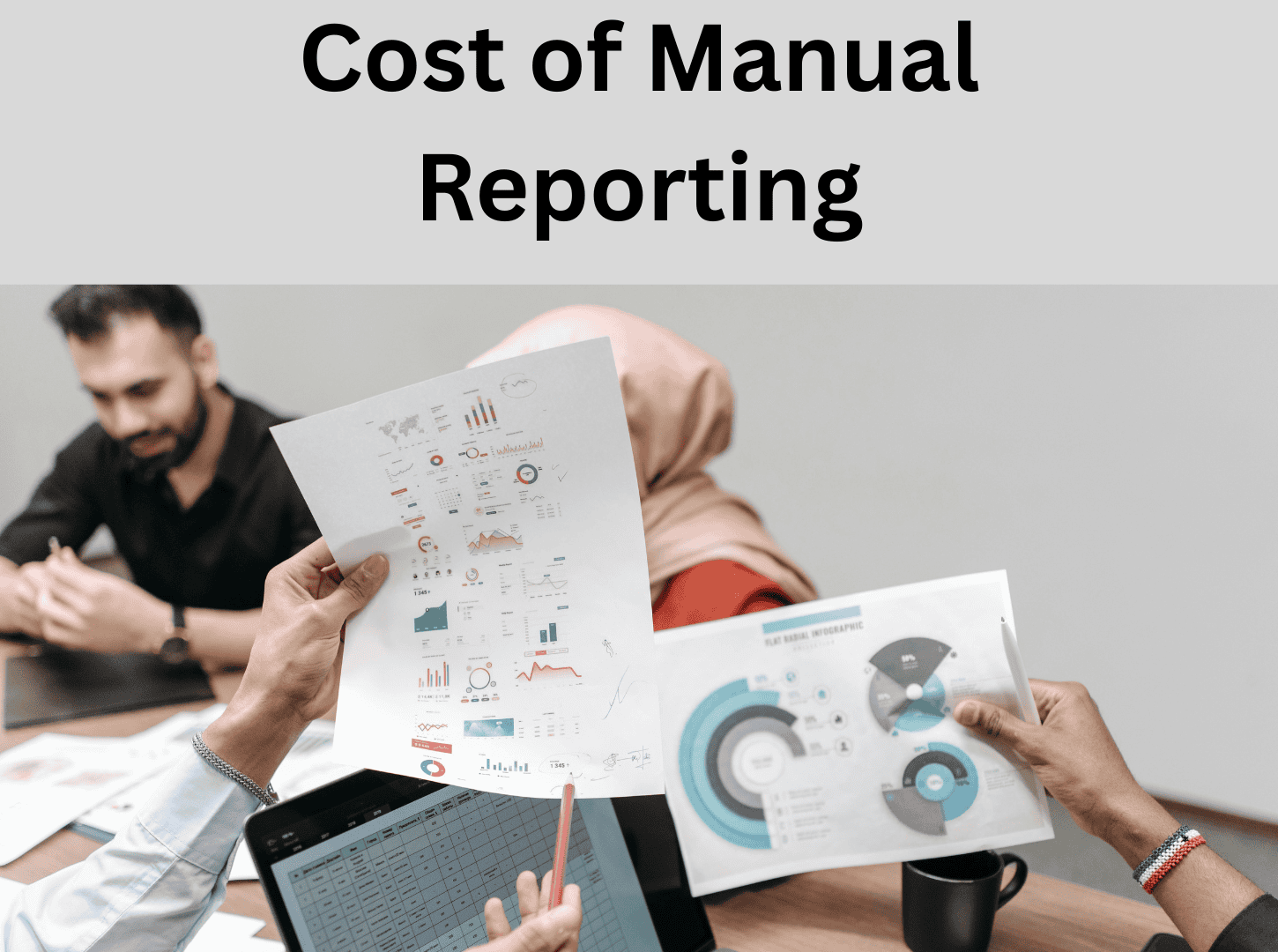
Real Cost of Manual Reporting
On the surface, pulling numbers from platforms like Google Analytics 4, Meta Ads, Shopify, Ahrefs, and Google Ads into spreadsheets or slide decks may seem like just part of the job.
But in reality, manual reporting is one of the most outdated and inefficient processes still normalized across modern marketing teams.
When you break down the numbers, the cost is far bigger than most agencies realize.
| Cost | Annual Impact |
|---|---|
| Time (4 hours/week × 10 clients) | $83,200 |
| Opportunity (9% ROAS improvement + churn) | $324,000 |
| Accuracy (client churn or error correction) | $12,000–$50,000 |
| TOTAL | $419,200–$457,200 |
Let’s unpack the real financial impact.
1) Time Cost: The Silent Profit Killer
Manual reporting eats hours, every week.
The workflow often looks like this:
- Logging into multiple platforms (GA4, GSC, Meta Ads, Google Ads, Shopify, etc.)
- Exporting CSVs
- Cleaning and formatting data
- Combining sources in spreadsheets
- Creating charts
- Copying into presentations
Typical analyst(s) or marketer(s) spends about 4 hours per week pulling, cleaning, and formatting data for a single client.
It might take less, say 3 hours or more, say 5 hours. But let’s go with 4 hours as the average.
With an average hourly rate of $40, let’s do the math:
- 4 hours per week × $40/hour = $160/week per client
- $160 × 52 weeks = $8,320 per year, per client
If you manage 10 clients:
- $160 × 10 clients = $1,600 per week
- $1,600 × 52 weeks = $83,200 per year
That’s one full-time analyst or marketer doing nothing but moving numbers from one place to another.
Instead of strategy, optimization, or growth work
In most agencies, manual reporting takes the entire Monday working hours of significant number of their employee depending on the number of clients they manage.
2) Opportunity Cost: What You’re Not Doing Instead
Every hour spent on manual reporting is an hour not spent on:
- Campaign optimization, which drives client ROI
- Creative testing, which improves performance
- Funnel improvements, which increase conversion
- Client strategy calls, which deepen relationships
- Business development, which brings new revenue
Manual reporting doesn’t just cost time, it delays growth and revenue.
If those analyst(s) or marketer(s) spent those 4 hours/week on client optimization work instead, they could:
- Actually analyze what’s working and what isn’t
- Run experiments and test new strategies
- Identify performance problems before clients do
- Have strategic conversations with clients instead of just delivering numbers
But they can’t, because they’re in spreadsheet mode.
And this is where it gets painful.
Imagine one of your clients is spending $10,000 per month on paid ads and they have a healthy 3:1 return on ad spend (ROAS).
That means they’re generating $30,000 in monthly revenue from those ads.
Now ask yourself: What if your team had more time to optimize?
With just 4 hours per week of dedicated optimization work: A/B testing creatives, refining audiences, eliminating budget waste, adjusting bid strategies, exploring new channels, you could realistically improve that ROAS by 9%.
Here’s what that looks like:
- Current ROAS is 3:1 and Current monthly revenue is $30,000
- Improved ROAS is 3.27:1 (a 9% boost) and New monthly revenue is $32,700
- Improvement is $2,700 per month, that is $32,400 per year in additional revenue per client
But your analyst is pulling CSVs instead.
Across 10 clients:
10 clients × $10,000/month average spend = $100,000/month in managed ad budget
- Current revenue being generated: $300,000/month (at 3:1 ROAS)
- Potential revenue with optimization: $327,000/month
- Missing: $27,000 per month in client revenue
- Per year: $324,000 in growth that your clients aren’t seeing
3) Accuracy Cost: Human Error Is Inevitable
Manual processes are human processes and human processes introduce errors.
Someone copies a wrong number, a formula breaks, a date range mistake, a custom metric is calculated one way this week and a different way next week, etc.
None of these feel like huge problems in the moment. But together, they create something dangerous: your reports can’t be trusted.
Here’s what happens when reports have errors:
A client looks at their weekly report and sees what looks like a performance drop.
It wasn’t a drop, it was a reporting error.
But the client doesn’t know that. They think their campaigns failed and made a bad decision based on that wrong data. That could easily cost them $5,000–$20,000.
Or they think that you are not delivering.
Both lead to the same outcome, they lose confidence.
Possible Outcome 1: The Client Leaves
If they lose confidence, they will probably leave.
A conservative average client lifetime value is $15,000–$30,000
If you lose one client to this, that is $15,000–$30,000 in lost revenue for your agency.
Possible Outcome 2: The Client Stays (But You Still Pay)
Maybe the error gets caught before serious damage happens.
The client doesn’t leave. But someone on your team now has to track down the mistake and fix it.
That’s usually 2-3 hours per month per client spent troubleshooting and recalculating.
So, if this happens at least once per month or to just one of the reports, the potential cost is:
- 2.5 hours × $40/hour × 10 clients = $1,000 per month
- $1,000 × 12 months = $12,000 per year
So, you either lose the client which cost you $15,000 to $30,000, or you spend $12,000 fixing the mess.
That makes the total cost of manual reporting between $419,000 and $457,000 per year for a 10-client agency.
Cost that is avoidable. But how?
The Solution is an Automated Dashboard That Do the Work For You
You don’t need a better spreadsheet.
The answer is an automated dashboard.
A data-driven and interactive report that updates automatically every morning with fresh data without any manual exports, copy-paste, delays, and errors.
Your team gets back 4 hours per week per client. Your analysts actually analyze, your marketers optimize, and your reports are accurate.
Your clients see interactive insights instead of waiting for the static weekly report.
That’s what we help you achieve here at Data Clare with either our ready-to-use Data Studio templates or the custom Data Studio dashboard.
Option 1: Data Clare Data Studio Templates
Our pre-built Data Studio report templates are designed for agencies exactly like yours if you want to get started fast.
What you get:
- Professional dashboards for GA4, Search Console, Google Ads, combination of 2 or all of them into a unified view
- Pre-configured metrics and dimensions
- Deploy in minutes, not days
- Save 16+ hours per month on reporting
- Start optimizing immediately
- Duplicate for all clients without hiring more reporting staff
Perfect if you want to eliminate manual reporting fast and affordably.
Option 2: Data Clare Custom Data Studio Dashboards
For agencies with more data stacks than our templates currently covers or specialized workflows, we build custom dashboards tailored to your business.
What you get:
- Unified dashboards pulling from all your sources
- Custom calculations and metrics
- White-label dashboards
- Turn reporting into a competitive advantage
- Reclaim $400,000+ in annual efficiency and growth
- Duplicate for all clients without hiring more reporting staff
Perfect if you want a scalable system that becomes part of your agency’s secret sauce.
The Cost of Automation
Manual reporting costs you $419,000–$457,000 per year. Automation costs significantly less.
Data Clare Templates run between $79 to $219 (one-time payment).
You pick based on how many data sources you’re connecting. There’s no additional cost for native connectors like GA4, Google Ads, and Search Console. Ready in minutes.
Data Clare Custom Dashboards start at $150 for simple builds and goes up to a few thousand Dollars depending on the number of pages and data sources you need. This is a one-time development cost.
If you’re connecting third-party platforms like Shopify, Meta Ads, TikTok, or email tools, those connectors require annual or monthly renewals (typically $1,000–$5,500/year for the plans that have no row limits, supports hourly refreshes, etc).
Even with all these costs combined, you will still be saving over $400,000 per year compared to manual reporting.
The math is simple. Spend a few hundred to a few thousand dollars upfront, recover hundreds of thousands in year one.
That’s not an expense, it is an investment.
Which One Is Right For You?
If you are just getting started with dashboard automation and want quick wins, start with templates.
If you are ready to scale, go custom.
Either way, you’re recovering more than $400,000 per year that manual reporting is currently costing you.
Reach out to Data Clare today, let’s turn your reporting into something that actually drives growth and gets your team back to doing the work that matters.


A Data Studio expert that help e-commerce and marketing teams transform their business data into an actionable Data Studio dashboard that cuts hours of manual reporting and delivers real-time business insights.